
Choosing between hair wigs and hair patches is easier when you begin with the area you want to cover. A full wig covers most of the scalp, while a hair patch—also called a partial hair system—covers a defined area such as the top, crown or front. The practical choice depends on coverage, fit, attachment, maintenance and budget.
Use this guide to prepare better questions before shopping or speaking with a fitter. You can find future educational articles on the Wovana Hair blog.
Quick answer: Choose a hair patch when existing hair can blend around a localized area and you are comfortable with a precise attachment routine. Choose a full hair wig for broad coverage or a complete hairstyle. In both cases, verify measurements, base, fibre, colour, density and care requirements before buying.
What is the difference between a hair wig and a hair patch?
A hair wig is built on a cap designed to cover most or all of the scalp. Cap styles vary, but the finished piece provides a complete hairstyle rather than relying heavily on the wearer’s own hair for blending. Hair wigs are available for men and women, in human hair, synthetic fibre and blended constructions.
A hair patch is smaller. It is shaped to replace coverage in one defined zone and is blended into the hair that remains around it. Depending on the wearer and design, it may be secured with tape, liquid adhesive, clips or another fitting method. Base size and contour therefore matter as much as the length of the hair.
Terminology is not perfectly standardized. “Hair system,” “hair replacement system,” “topper” and “hair patch” can overlap in everyday shopping language. Always compare the actual base dimensions, cap coverage and attachment method instead of relying only on the name.
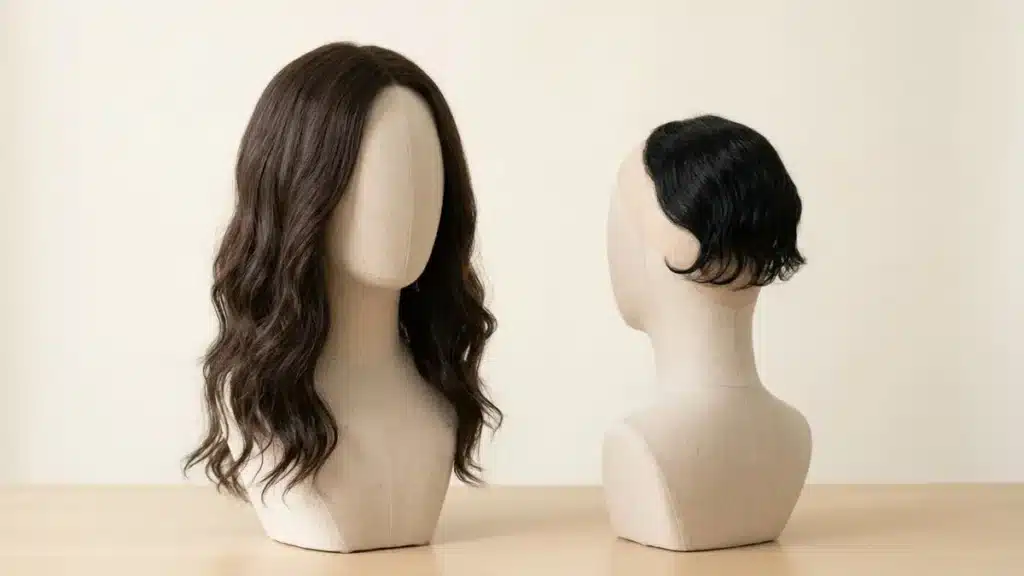
Hair wig vs hair patch at a glance
| Factor | Full hair wig | Hair patch or partial system |
|---|---|---|
| Coverage | Most or all of the scalp | A defined area such as top, crown or front |
| Blending | Creates a complete hairstyle | Must blend with surrounding natural hair |
| Fit | Based on cap circumference and head shape | Based on the exact coverage area and base contour |
| Attachment | Cap adjustment, grips, clips, tape or adhesive depending on design | Often clips, tape, adhesive or a fitted combination |
| Daily routine | Many designs can be removed as a complete piece | Routine varies from daily removal to longer wear |
| Colour matching | Can establish an entirely new overall shade | Usually needs a close match to nearby hair |
| Density | Chosen for the whole hairstyle | Must coordinate with the wearer’s perimeter hair |
| Maintenance | Depends on cap and fibre | Depends on fibre, base and attachment residue |
1. Start by mapping the coverage area
Stand in bright, indirect light and assess the front, top, crown, sides and back separately. Photographs from above and behind can reveal an area that is difficult to see in a mirror. The goal is not to diagnose the cause of hair loss; it is simply to understand the physical area a cosmetic hairpiece needs to cover.
A partial system works best when its base fully covers the intended area while leaving a practical margin for attachment and blending. A base that is too small may expose the edge as the surrounding area changes. A base that is unnecessarily large can make blending and maintenance more complicated.
For localized top or crown coverage, compare men’s hair patches and women’s hair toppers by their listed base measurements—not only by hairstyle. For broader coverage, review complete women’s hair wigs or men’s hair wigs.
2. Compare base construction, not just hair length
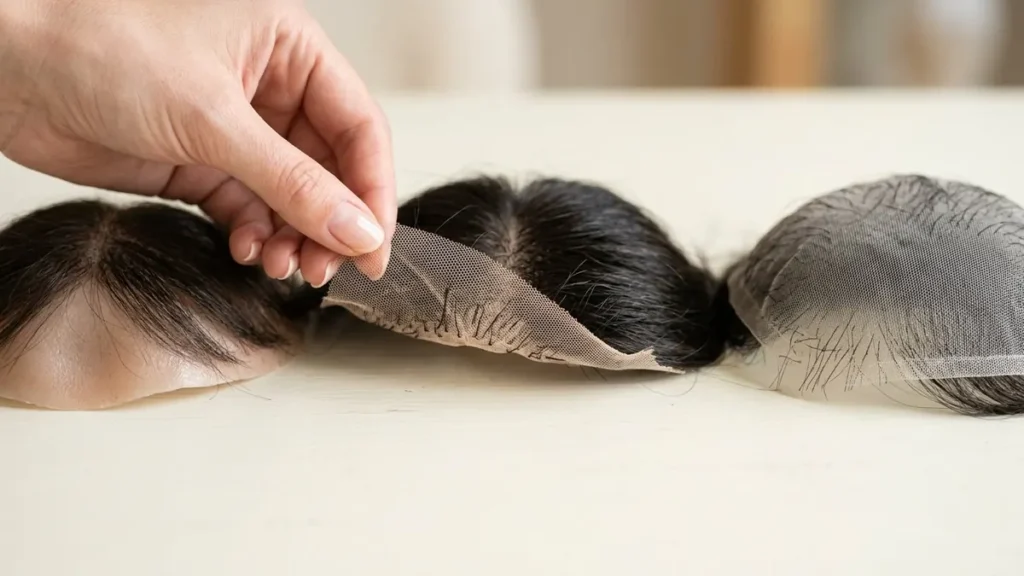
The base is the foundation that holds the hair and sits against the head. It affects edge appearance, airflow, durability, cleaning and which attachment methods are practical.
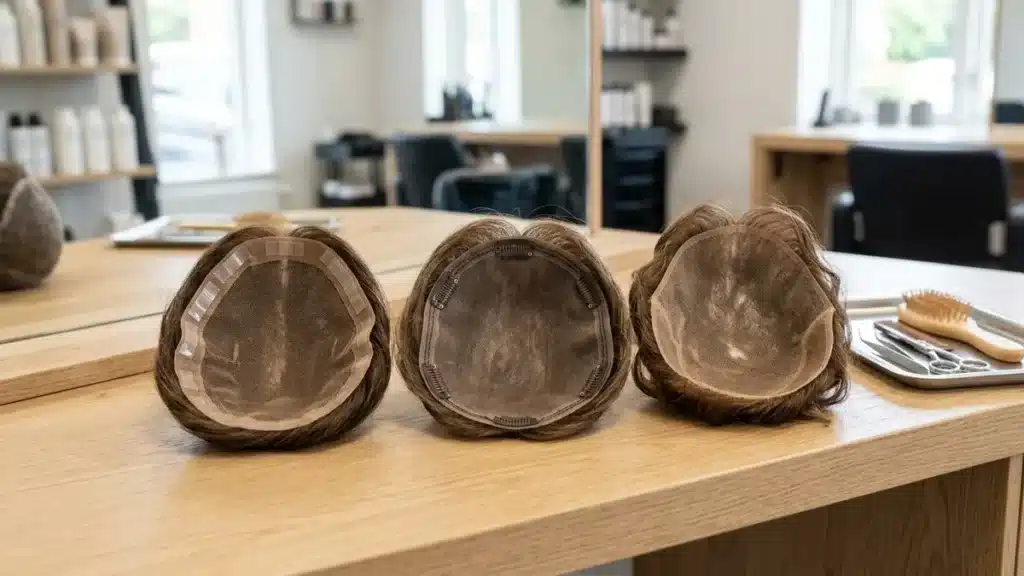
Skin-style bases
Thin polymer or “skin” bases create a close surface and defined perimeter for tape or adhesive. Thinner material may look subtler but require gentler handling; a thicker base can be easier to handle. Confirm where it can be taped and how residue should be removed.
Lace bases
Lace is a fine, breathable mesh whose front edge needs careful handling. Tape or adhesive must be placed only in suitable areas. Density, knot appearance and the relationship between lace colour and scalp can affect the result.
Monofilament bases
Monofilament is a fine woven material that supports ventilated hair. Some pieces combine it with a stronger perimeter, lace front or skin section. Products sharing the label can still differ, so compare the complete base diagram and care instructions.
Hybrid bases combine materials to balance different priorities. The most useful question is not “Which base is best?” but “Which construction fits my climate, attachment routine, desired edge and maintenance comfort?”
3. Choose human hair or synthetic fibre deliberately
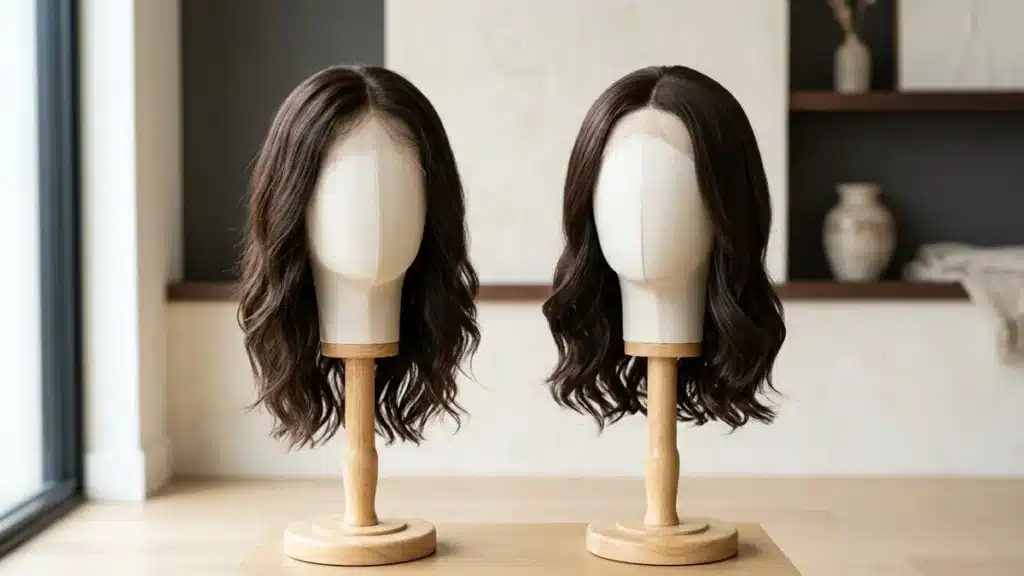
Human hair wigs and patches usually offer more flexibility for cutting, restyling and creating a customized finish. They can also respond to humidity, require restyling after washing and need appropriate conditioning. Colour processing and high heat can shorten useful life, so any chemical or thermal service should follow the supplier’s instructions.
Synthetic hair usually keeps its preset pattern more consistently and can simplify daily styling. Standard synthetic fibre can be damaged by heat; only use heated tools if the product is specifically identified as heat-friendly and stay within its stated temperature limit. Friction and unsuitable products can create frizz or fibre wear.
The visual difference is not determined by fibre alone. Density, colour dimension, hairline design, length, cut and fit all influence the result. Compare the fibre specification on individual products rather than assuming every human-hair or synthetic piece performs the same way.
4. Measure before selecting a size
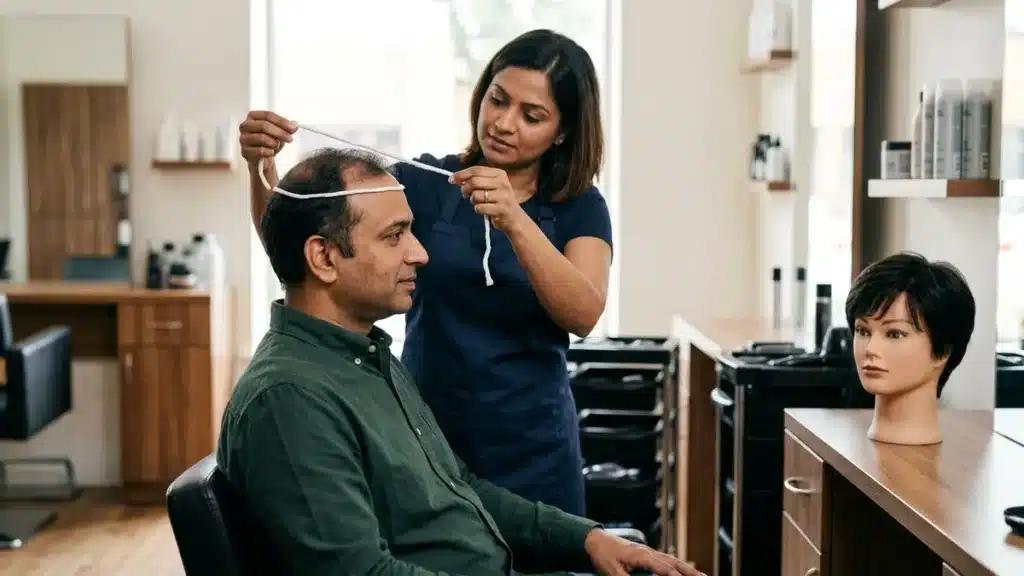
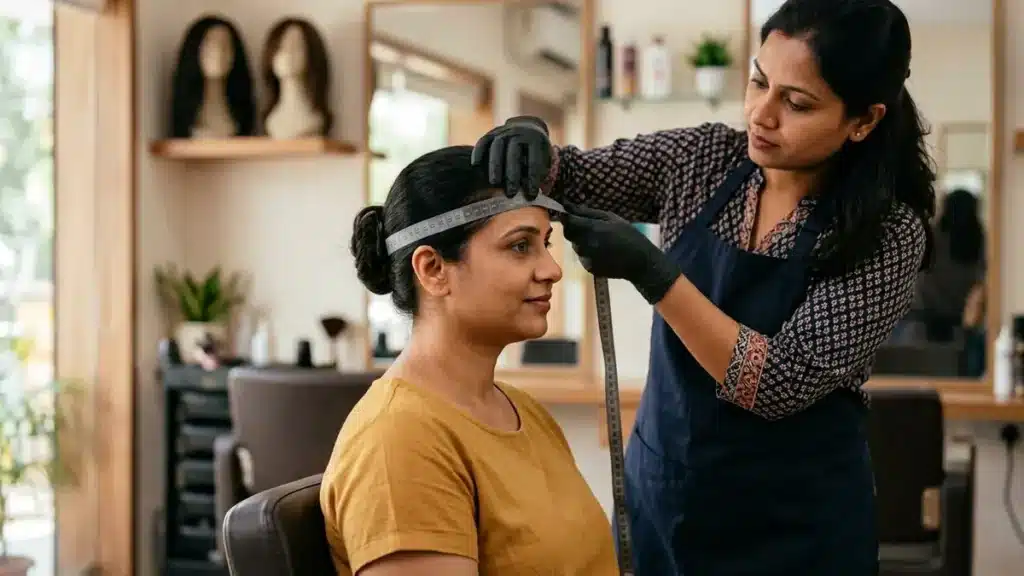
For a full wig, measurements commonly include circumference, front-to-nape, ear-to-ear and temple-to-temple. Keep the tape flat and comfortably snug. Position natural hair as it will be worn under the cap, then use that product’s size chart because size labels are not universal.
For a hair patch, map the area lengthwise and across its widest point. Note the contour of the front hairline and where stable perimeter hair begins. If a stock base is larger than required, confirm whether that specific construction can be trimmed and who should do it. Cutting into an unsuitable base can damage ventilation or weaken the perimeter.
Fit affects security and comfort. A tight cap can create pressure, a loose one can shift, and the wrong partial-base contour may lift. Ask for fitting guidance before altering a piece.
5. Match colour, texture and density in natural light
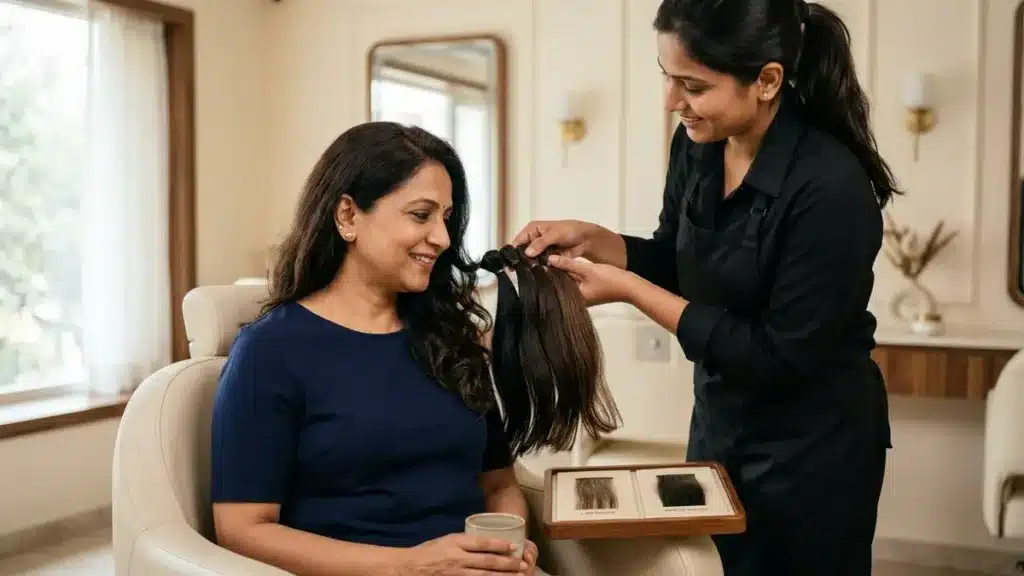
Colour names such as “natural black” are not universal standards. Compare a physical swatch with the mid-lengths and ends of surrounding hair in indirect daylight. For a patch, include any grey percentage and note whether the perimeter hair is coloured.
Texture must coordinate too. Straight, wavy and curly are broad labels; curl diameter and direction still differ. Human hair may be adjusted, while synthetic texture is largely built into the fibre.
Density is often overlooked: more is not automatically more natural. A partial system should transition into the sides and back, while a full wig should suit the wearer’s style and comfort. A stylist can refine extra length more easily than a fundamentally wrong base or density.
6. Understand the attachment routine
Attachment should be chosen with the base design, skin condition, activity level and desired removal schedule in mind.
- Clips simplify removal when enough stable natural hair can support them. They should not pull painfully.
- Tape comes in different shapes and hold categories. Use only a type suitable for the base and follow its preparation and removal instructions.
- Liquid adhesive can bond the perimeter but requires careful application, curing and cleanup. Skin and base compatibility are essential.
- Adjustable cap features or grips may secure some wigs with less reliance on adhesive.
Never apply adhesive over broken or inflamed skin. Follow patch-test directions and stop if irritation develops. Release a bonded piece with a compatible remover rather than pulling it away dry.
Wovana carries separate categories for hair patch tapes and glues and removers. Check compatibility with your exact base rather than choosing only by advertised hold time.
7. Plan the complete care routine
Maintenance begins before washing. Detangle from the ends upward while supporting the base. Follow the supplied instructions because fibres and bases can require different products.
Use cool or lukewarm water unless instructed otherwise. Avoid twisting or vigorous rubbing. Rinse in the hair direction, blot with a towel and dry the piece with suitable support. Handle a wet base gently.

Adhesive systems need perimeter and scalp cleanup. Soften residue with a compatible remover instead of scraping. Rushed removal can stretch skin bases, fray lace or pull through ventilated hair.
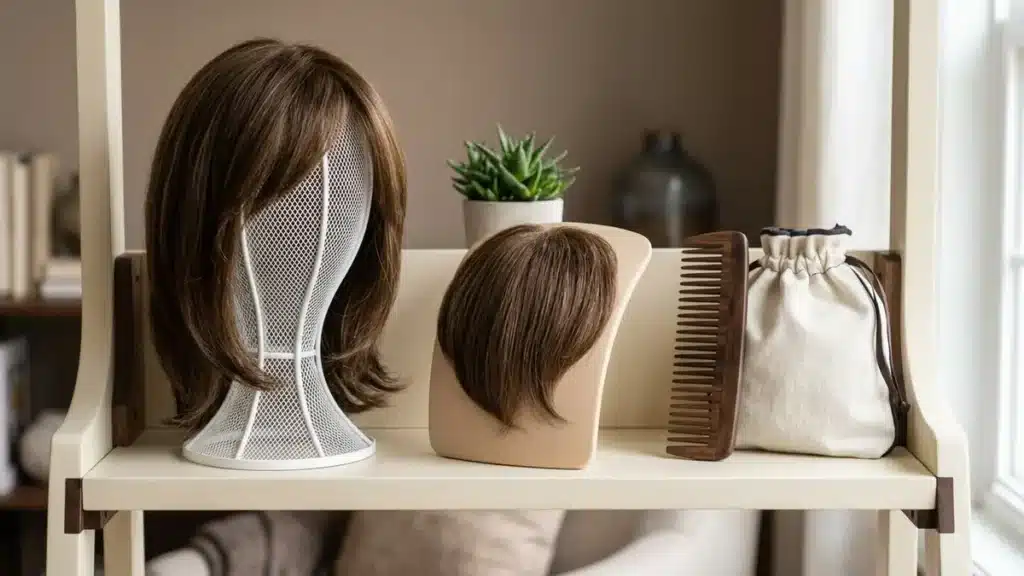
Store a clean, fully dry piece away from sun, heat and dust. Use a breathable wig stand or a smooth curved form for a patch. Keep adhesives and solvents sealed away from children and flames.
There is no universal lifespan. Wear frequency, base, fibre, friction, heat, cleanup and handling all matter. Include maintenance time and supplies in the buying decision.
8. Compare total cost, not only the listed price
The lower-priced option is not always the lower-cost routine. Consider:
- Initial hairpiece price
- Cutting, blending or professional fitting
- Tape, adhesive and remover
- Shampoo, conditioner and styling products approved for the fibre
- Maintenance appointments
- Repairs, re-ventilation or replacement when applicable
- A backup piece if the system is worn daily
Human hair, custom sizing and delicate bases often cost more, but price does not prove suitability. A simpler stock piece may be more practical than an advanced base you do not want to maintain.
Wovana’s website converts INR catalogue prices for supported visitor currencies, but exchange rates can change. Confirm the currency, variation, shipping information and complete checkout total before ordering. You can compare available options in the Wovana Hair shop.
A practical decision checklist
Before ordering hair wigs or hair patches, write down your answers:
- Do I need localized or full-scalp coverage?
- What are my exact cap or base measurements?
- Will the piece blend with existing hair, or create the complete style?
- Which base construction suits my preferred attachment method?
- Do I want daily removal or a longer-wear routine?
- Can my skin and existing hair comfortably support that method?
- Is the fibre human hair, standard synthetic or heat-friendly synthetic?
- Does the colour, texture and density match my goal?
- What products and appointments will maintenance require?
- What is the return or exchange policy for this hygiene-sensitive item?
Save screenshots of the exact colour, size and variation selected. Read the current product description and policy before checkout; hairpieces may have stricter return conditions once worn, altered, cut or exposed to adhesive.
Frequently asked questions
Is a hair patch the same as a wig?
No. A hair patch covers a defined area, while a wig usually covers most or all of the scalp. Because “hair system” is used broadly, check measurements and construction.
Can a hair patch be removed every day?
Some clip or short-hold methods support frequent removal; other systems are fitted for longer wear. The answer depends on the base, attachment product, skin and fitting plan.
Are human hair wigs always better than synthetic wigs?
No. Human hair offers styling flexibility; synthetic hair can retain a preset style with less restyling. Choose according to your look, climate, time, heat needs and budget.
How do I make a hair patch look more natural?
Accurate coverage, base contour, colour, texture, density, hairline placement and professional blending all matter. Buying a denser or longer piece does not automatically improve the result.
Should I buy the hairpiece before speaking with a stylist?
If the piece needs trimming, colour adjustment or blending, consult the intended fitter first. Ask what base, density, excess length and attachment area they need.
Hair loss and scalp health
A wig or hair patch is a cosmetic coverage option; it does not diagnose or treat the cause of hair loss. Hair loss has many possible causes. The NHS hair-loss guidance recommends speaking with a medical professional when you are worried about hair loss, while the American Academy of Dermatology notes that some conditions can begin with sudden, defined patches. Seek qualified medical advice for sudden loss, scalp pain, burning, significant itching, inflammation or other concerning symptoms.
Important: Wovana Hair articles provide general product and care information. Hair loss and scalp concerns can have different causes; consult a qualified healthcare professional when you need medical advice.
About this guide
Published by Wovana Hair to help shoppers compare coverage products more carefully, this guide uses product-construction principles, current category information and independent medical references for its limited health note. The images are digitally generated illustrations and do not depict exact Wovana products or guaranteed results. Product specifications and policies can change; verify the live product page before ordering. Learn more about Wovana Hair.
Choose for your coverage and routine
The best choice is a correctly sized piece whose coverage, base, fibre, colour, density and care routine fit the wearer. Map the area, verify specifications and decide how much maintenance you can comfortably manage.