
Indian wedding season runs from late October to February, and every year the same calls come in during the last two weeks: a groom who wants a hair patch for his wedding in eleven days. It is doable, but it is not the way to get the best result. A hair patch at a wedding is not like a hair patch at the office — it has to survive a haldi, a sangeet with an hour of dancing, a baraat in the afternoon sun, a safa tied tight across your forehead, a twelve-hour day of flash photography, and a family that will look at these pictures for forty years.
This is the groom’s plan: when to start, what to book and when, how to colour-match for Indian wedding lighting, how to handle the safa and the sehra, the sweat-proofing protocol for the dance floor, and the small kit that saves the day.
Quick answer: start 8–12 weeks before the first function if you want a custom-fit unit, or 3–4 weeks minimum with a stock size. Have the unit fitted and cut in at 6 weeks, wear it for real events well before the wedding, do a flash-photo test at 2 weeks, and get the final cut and blend 5–7 days out. Book the last re-bond 3–5 days before the wedding — never on the morning itself. On the day: blot sweat, don’t wipe it; keep aerosol sprays away from any flame; and put the pins into the safa band, not the patch.

The 90-day groom timeline
| When | What to do | Why it matters |
|---|---|---|
| 10–12 weeks out | Consultation, scalp check, measurement or template | Custom units need design and build time; a scalp condition found now can be treated |
| 8 weeks out | Order the unit; decide base type and density | Leaves room for a remake if the colour or fit is wrong |
| 6 weeks out | First fitting, cut-in and blend with your own hair | This is the appointment that decides how natural it looks |
| 4–6 weeks out | Wear it to a real event — a cousin’s engagement, a work dinner | You learn its behaviour before the day that can’t be reshot |
| 2–3 weeks out | Flash-photo test; adjust density or hairline if needed | Flash shows gaps and density mismatches that daylight hides |
| 2 weeks out | Pre-wedding shoot, if you have one | Second real-world test, in the same lighting as the wedding |
| 5–7 days out | Final trim, tidy the sides, fresh colour blend | Enough time for skin to settle and the cut to look lived-in |
| 3–5 days out | Last full re-bond, fresh glue or tape | Bond at its strongest for the functions; scalp has recovered by the day |
| Day of | Comb, blot, check the front edge, go | Nothing new, nothing drastic, no scissors |

Why not just use hair fibres for the wedding?
Fibres and coloured sprays are a genuine option for a normal day, and plenty of grooms ask about them because they are cheaper and instant. For an Indian wedding they fall short for four reasons: they colour the scalp and hair shaft on the surface, so close-up flash photographs show the powder; sweat dissolves them into streaks, which is exactly what a sangeet produces; they cannot be rained on, hugged or leaned against; and the haldi paste, coconut oil and turmeric will lift them within minutes.
| Option | Looks in flash photos | Sweat / dancing | Headwear pressure | Cost |
|---|---|---|---|---|
| Hair patch (bonded) | Good — real hair, real hairline | Holds with a fresh bond and a proper base | Fine if the safa is fitted to the band, not the hairline | ₹8,000–₹30,000 + fitting |
| Hair fibres / shake-on powder | Visible at close range under flash | Streaks and runs | Rubs off on the band | ₹1,500–₹4,000 |
| Coloured scalp spray | Flat, matte, obvious in HD | Runs badly | Transfers to fabric | ₹800–₹2,500 |
| Wig / full-cap system | Good, but hotter and heavier | Heat build-up is the issue | Hard with a tightly tied safa | ₹15,000–₹60,000 |
| Nothing / restyle only | Depends entirely on your hairline | No risk | No risk | ₹0 |
If your wedding is inside four weeks and you have never worn a system, the honest advice is: use a patch for the pre-wedding shoot if you can, and consider fibres for the wedding itself rather than rushing a bond you have not tested. A rushed patch is more visible than thinning hair.
Colour matching for wedding lighting
Indian wedding photography is high-contrast, flash-heavy, and often shot in warm tungsten light mixed with daylight. Three colour mistakes show up again and again:
1. Going one shade too dark. Jet black against dark brown side hair reads as a solid block in flash. If your natural hair is a soft black or a dark brown, match the tone, not the name.
2. Ignoring grey. A groom in his late thirties with 20–30% grey at the temples and a completely black patch looks wrong in every single photograph. Salt-and-pepper units exist for exactly this, and a 10–20% grey blend will photograph far better than pure black.
Related guide: the colour step deserves its own file — our hair patch colour matching guide walks through depth, undertone and grey by zone, the 2–3 cm root rule, the daylight-plus-white-paper check, and the local toning fixes that can save a unit that arrives a shade off.
3. Matching under the wrong light. Salon lights lie. Compare the sample to your own hair in daylight near a window and in a photo taken with flash — the flash shot is the one that matters.
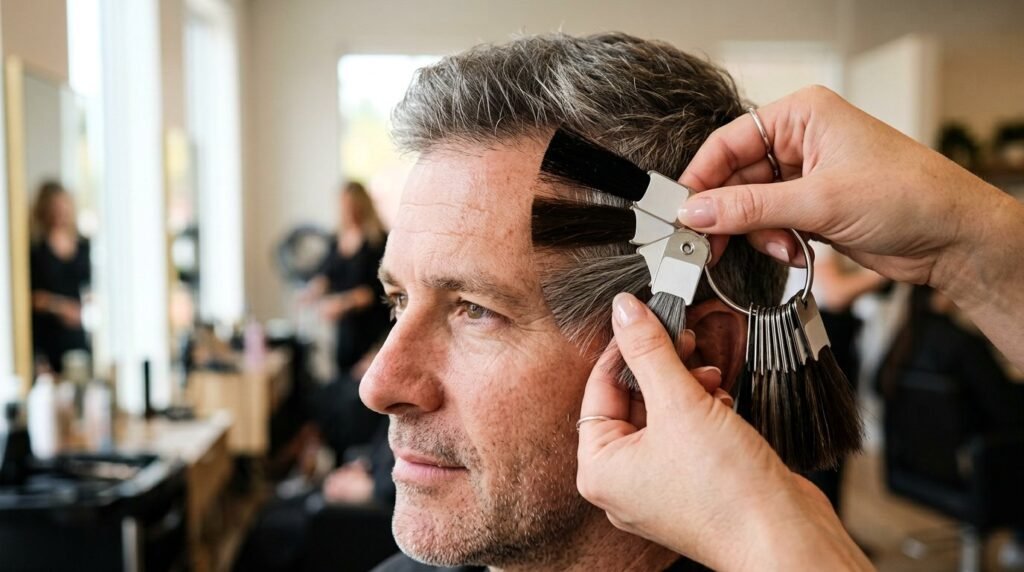
Send three things to whoever makes the unit: a small cutting of your side hair, two photographs (one in daylight, one with flash), and your age. If the unit arrives and looks slightly light in daylight, that is usually the better error — it reads correct in photographs, and it can be darkened by a stylist. Too dark cannot easily be fixed.
Designing the hairline for a groom
The 2026 look for grooms is not a wall of density at the front. Ask for a graduated hairline — a soft first row, a slight natural recession at the temples, and density that matches your side hair rather than exceeding it. A perfectly straight, high-density front edge is the single most common reason a patch looks like a piece in photographs, and it will look worse in ten years when you see the album.
Bring photographs of how you normally wear your hair, and if you have a barber you trust, bring his number. Getting the patch cut in by someone who understands your existing fade or taper is worth more than any base upgrade.
The safa, pagri and sehra problem
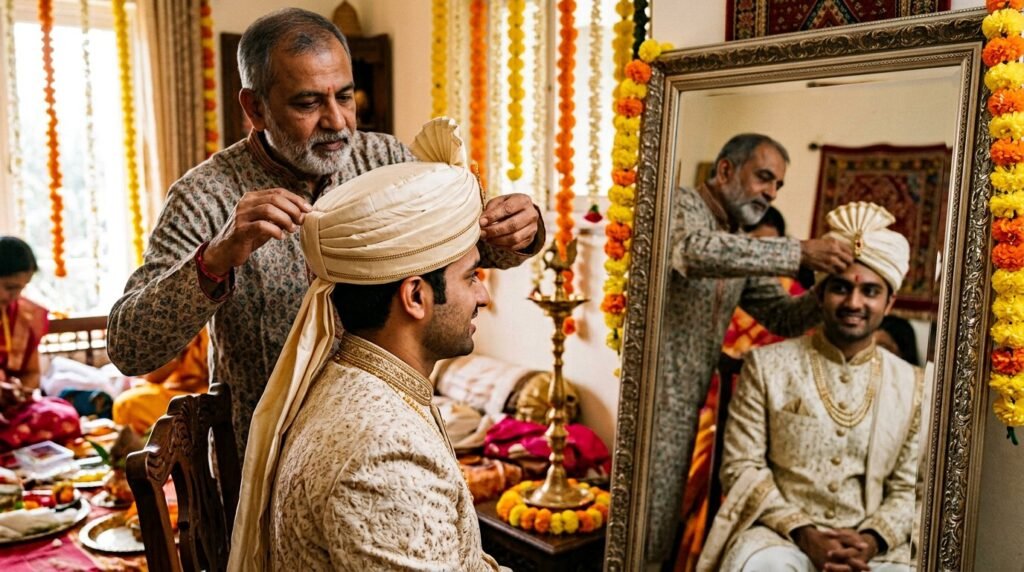
This is the part that catches grooms out, and it has nothing to do with the quality of the unit. A turban is tied with real tension across the forehead — precisely where the front edge of your patch sits. Tie one over a fresh patch without planning and you will either lift the front edge or flatten the hairline into a hard line.
Three rules:
1. Take your safa to the fitting. Have the unit cut in while wearing it, or take a photo of yourself wearing it to the fitting. The stylist can then set the front hairline height to sit just below the band rather than under it.
2. Pin into the fabric, never the patch. If the safa needs pins or the sehra needs anchoring, every pin goes into cloth or into your own hair — never through the base. A pin through lace or poly is a tear, and a tear at the front edge is visible in every photograph.
3. Rehearse it. Tie the turban at home a week before, leave it on for an hour, then check the front edge in a mirror and in a phone photo with flash. If the band is pressing the hairline flat, the safa needs to sit 1–2 cm higher or be tied slightly looser at the front.
Sweat-proofing for the sangeet and baraat
A wedding day in India asks more of a bond than a normal week does: mandap lights, packed halls, an hour of baraat dancing, and a scalp that stays damp for hours. Moisture is what lifts adhesive, so the plan is about freshness and behaviour, not about a stronger glue.
Book the re-bond 3–5 days out, not the morning of. Adhesive reaches full strength over roughly 24 hours, and a bond applied the same morning has not settled — plus any redness from the application has had no time to fade. Three to five days gives you both.
Use the right bond for a dance floor. A full glue bond holds best through heavy sweating; a tape bond is easier to remove and cooler, but a long sangeet can soften it. If you know you will dance for hours, ask for glue at the front hairline and tape around the sides and back — the hybrid most wearers settle on for events.
Blot, never wipe. Keep a clean cotton cloth in a pocket or with your best man. Press it against the temples and the forehead; wiping drags the fabric across the front edge and is how edges lift.
Take breaks. Ten minutes in an air-conditioned room between rituals does more for the bond than any product.
No aerosol near a flame. Hairsprays are flammable, and weddings have diyas, candles and pyrotechnics. Use a non-aerosol styling product, and keep any spray well away from open flame.

The haldi, and other messy rituals
Haldi paste stains everything it touches, including a human hair unit — turmeric on light or salt-and-pepper hair leaves a yellow cast that does not wash out completely. Ask your stylist about the day beforehand, and do three things: keep the paste at least two fingers’ width from the hairline; cover the front edge with a thin cloth or shower cap during application if the family will let you; and rinse with cool water immediately, not an hour later, if any does land on the unit. Mild shampoo, no scrubbing, air dry.
If you have a mehendi or pool party in the schedule as well, treat the patch like a garment: it can get wet, but it needs to dry properly afterwards and it should not sit wet against your scalp for hours.
Photographs: the two-week test
Two weeks out, do a proper flash test: stand against a plain wall, have someone photograph you from the front, three-quarters and side, with direct flash, indoors and out. Look for three things — the front edge, the density against your side hair, and the colour difference. Then fix whatever shows, because at that point it is still fixable.

The same test applies to your pre-wedding shoot. If the shoot is already booked, schedule it after the unit is cut in and worn once — a shoot is a free rehearsal for the wedding day itself.
Day-of kit
| Item | Why |
|---|---|
| Clean cotton cloth (2) | Blotting sweat without rubbing |
| Soft-bristle comb or brush | Tidying without pulling at the base |
| Small mirror | Checking the front edge before photos |
| Spare tape strips | An emergency fix for a lifted edge, if you have worn a tape bond before |
| Non-aerosol styling product | Flame-safe, and it does not wet the bond |
| Your stylist’s phone number | Faster than any internet advice, on the day |
| Printed function schedule | So the person helping you knows when the safa goes on and off |
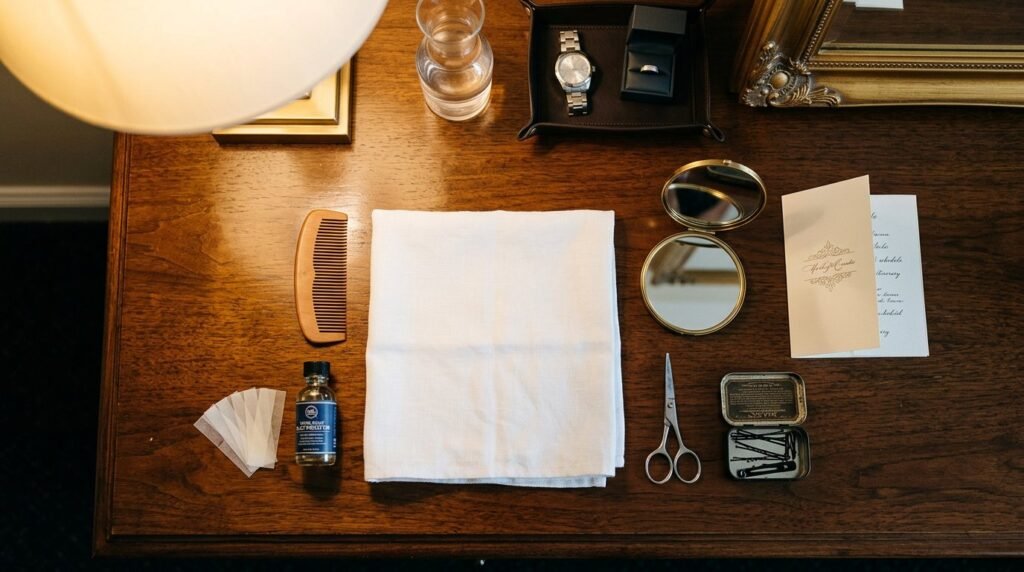
Hand the kit to your best man or brother, not to your mother, and tell one person what to do if an edge lifts: press, do not pull, and call the stylist. Most “disasters” on the day are a lifted corner and a panicking groom.
What it costs
| Item | Typical India range (2026) | Notes |
|---|---|---|
| Stock hair patch, 8×6 or 9×7 | ₹6,000 – ₹24,000 | Our Mono from ₹7,199 and Mirage from ₹15,599 |
| Custom unit to template | 1.3×–1.6× stock price | Adds 3–6 weeks |
| Cut-in, blend and styling | ₹1,000 – ₹2,500 | Do it at 6 weeks, not 6 days |
| Re-bonds through the wedding week | ₹1,000 – ₹2,500 each | Two bonds: one at 3–5 days, one for the reception |
| Wedding-week touch-up kit | ₹1,500 – ₹2,500 | Scalp protector ₹839, C22 remover ₹959, tape |
| Total, stock route | ₹10,000 – ₹32,000 | Roughly what the photographer’s second shooter costs |
For the full yearly running cost, our price guide sets it out; if you are still deciding whether to buy at all, patch vs transplant compares the two honestly, and wigs vs patches covers the headwear question.
Five mistakes grooms make
• Starting in the last three weeks. No time to fix colour, density or fit — and no wear-in, so the unit feels foreign on the day.
• Trying a new style on the wedding morning. A fresh cut, a new product, a different part: all of it shows.
• Cutting or bonding on the day. Skin irritation from a fresh bond is visible in close-ups, and flash finds it.
• Ignoring the safa until the morning of. Fit it, pin it and photograph it a week early.
• Over-tightening the look. Density too high, hairline too straight, colour too dark — the three things that make a good unit read as a wig in photographs.
Honeymoon and the weeks after
If you are travelling somewhere hot and humid, pack the same kit plus a spare tape roll, and plan a re-bond before you fly. Coastal humidity and pool water will test a bond far more than the wedding did; our humidity guide covers the routine, and the 10-step care routine is the weekly discipline that keeps the unit looking right for months after.
One last thing worth saying plainly: get the scalp checked before you start. If you have redness, flaking or a flare-up, deal with it before the fittings rather than discovering it a week before the wedding — our scalp safety guide explains what needs a dermatologist, and the sizing guide covers the measurements you will need at the first appointment.


Frequently asked questions
How many days before the wedding should I get a hair patch?
Order 8–12 weeks out for a custom unit, or 3–4 weeks for a stock size. Have it cut in six weeks before, wear it at least twice before the wedding, and book the final re-bond three to five days before the first function — never on the morning of.
Can I wear a safa or pagri with a hair patch?
Yes, and it is common. Take the safa to the fitting so the front hairline is set to sit just below the band, pin into the fabric and never through the base, and rehearse wearing it for an hour a week before.
Will the patch survive the sangeet and baraat dancing?
With a fresh bond, yes. Use glue at the front and tape at the sides and back if you plan to dance for hours, blot sweat with a cotton cloth instead of wiping, and take short breaks in air conditioning.
Can I do a haldi with a hair patch on?
You can, with care. Keep the paste at least two fingers’ width from the hairline, cover the front edge during application if possible, and rinse immediately with cool water if any lands on the unit. Turmeric can leave a lasting yellow cast on lighter hair.
Should I choose black or salt-and-pepper?
Match your own side hair and your age. If you have 20–30% grey at the temples, a 10–20% grey blend photographs far better than solid black. When in doubt, go slightly lighter than you think you need.
What if my wedding is in two weeks?
Go with a stock size in a base type your stylist can cut in quickly, keep the change conservative, and consider hair fibres for the wedding itself if you have never worn a unit. A rushed, untested patch is more visible than thinning hair.
Can I swim on my honeymoon with the patch on?
Yes, with a bond that has fully cured (about 24 hours) and a re-bond before you travel. Rinse the unit with fresh water after the sea or pool, and do not let it sit wet against your scalp for hours.
How long will the patch last after the wedding?
Between 3 and 12 months depending on the base: skin and lace bases wear faster, monofilament lasts longer. Our lifespan guide has the numbers by base type, and the base guide explains which suits Indian heat.
Timings and prices here are general guidance for Indian weddings and current retail ranges. Every scalp is different — book a consultation with a qualified stylist or dermatologist before your first fitting, and follow their advice over any general timeline.