
If you are losing hair and weighing your options, the two names you will hear most often are hair patch (a non-surgical hair system) and hair transplant (surgery that moves your own hair follicles). They sit at opposite ends of the spectrum: one is a reversible, cosmetic product you can wear today; the other is a permanent procedure that changes your scalp itself.
Neither is “better” in the abstract. The right answer depends on your hair loss pattern, your budget, how much downtime you can accept, and whether surgery is safe and appropriate for you in the first place. This guide compares them honestly — cost, recovery, results, maintenance and risk — so you can walk into any clinic or store with clear questions. Find more practical guides on the Wovana Hair blog.
Quick answer: Choose a hair patch when you want an immediate, reversible, affordable result with no surgery or donor-area commitment. Choose a hair transplant when you are a suitable candidate, can afford ₹1.5 lakh or more, and want a permanent solution you are willing to wait 8–12 months to see fully mature.
What is a hair transplant?
A hair transplant moves healthy hair follicles from a donor area (usually the back and sides of the scalp) to thinning or bald areas. Modern clinics mostly use FUE (Follicular Unit Extraction), where individual grafts are extracted and implanted one by one, or FUT, where a thin strip of scalp is removed and dissected into grafts. The transplanted hair falls out within weeks and then regrows over the following months.

Because the grafts are your own permanent hair, a successful transplant is permanent. That permanence is also its risk: results depend heavily on surgeon skill, and a poor result or unnatural hairline is very difficult and expensive to reverse.
What is a hair patch (hair system)?
A hair patch — also called a partial hair system or men’s hair piece — is a non-surgical base (thin skin, lace or monofilament) with 100% human hair attached, worn over the thinning area. It is fixed with medical-grade tape or adhesive and blends with your own hair around it. There is no cutting, no donor area and no recovery time — you can wear one the same day you buy it. The material underneath matters just as much as the hair: thin skin, lace, monofilament and silk each trade realism against breathability and lifespan, so it is worth comparing the hair patch base types before you commit.
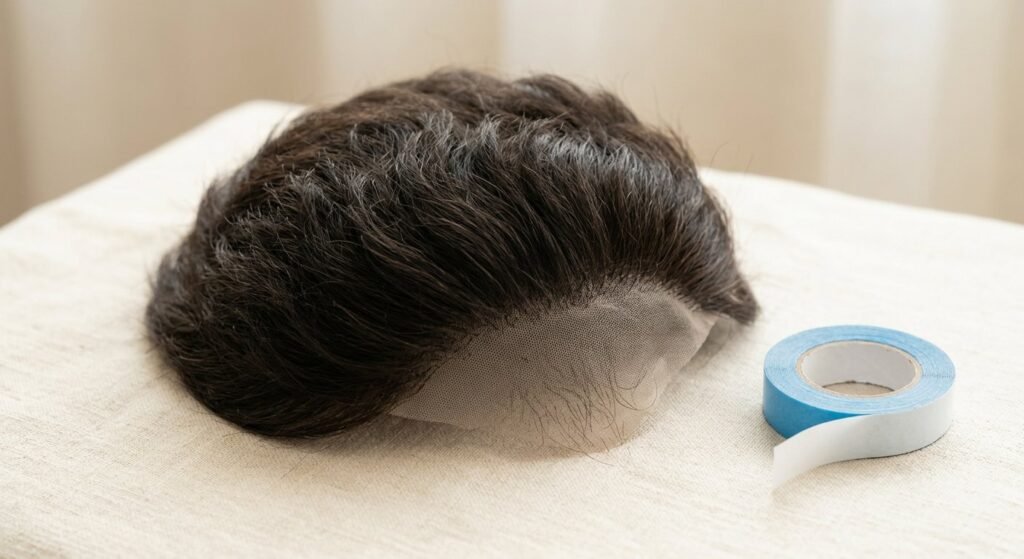
The trade-off is that a patch is a product, not a cure: it needs re-attachment every 1–2 weeks, periodic cleaning and a new system every few months to a year depending on quality and care. If you stop wearing it, you are back to your natural state — nothing is changed permanently, which many people consider the biggest advantage of all.
Hair patch vs hair transplant: at a glance
| Factor | Hair patch (system) | Hair transplant |
|---|---|---|
| Approach | Non-surgical cosmetic attachment | Surgical relocation of your own follicles |
| Result | Immediate, same-day | Visible at 4–6 months, full at 8–12+ months |
| Permanence | Reversible; needs periodic replacement | Permanent (for transplanted hair) |
| Upfront cost | Roughly ₹4,000 – ₹40,000+ per system | Roughly ₹40 – ₹150 per graft; 2,000–4,000+ grafts typical |
| Long-term cost | Replacement + maintenance over the years | One main surgery; optional future sessions |
| Candidacy | Almost anyone with thinning hair | Requires adequate donor hair and healthy scalp |
| Recovery | None | 1–2 weeks downtime; scabs, swelling possible |
| Risks | Skin sensitivity, attachment learning curve | Infection, poor growth, unnatural look if done poorly |
| Maintenance | Re-attach every 1–2 weeks, clean and restyle | Standard hair care; hair loss may continue elsewhere |
Cost comparison in India
Hair transplant pricing is usually quoted per graft. In India, quality clinics typically charge between roughly ₹40 and ₹150 per graft. A crown or frontal area often needs 1,500–3,000 grafts and a full scalp session 3,000–5,000+. Realistic totals for a good clinic usually land between ₹1.5 lakh and ₹6 lakh or more — and cheaper “deals” can mean fewer grafts than promised, poor survival rates, or an unnatural hairline that costs more to fix later.
Hair patch pricing starts far lower: a quality 100% human hair men’s patch typically costs between roughly ₹4,000 and ₹25,000, with premium custom systems going higher. Add tapes or glue (a few hundred to a couple of thousand rupees per month) and an occasional system replacement. Over five years a patch usually still costs a fraction of one transplant session — but it is an ongoing subscription rather than a one-time fix.
Note: prices are indicative and vary widely by city, clinic, material quality and customisation. Always ask for itemised quotes.
Pros and cons
Hair patch
- Pros: immediate results, no surgery or downtime, fully reversible, low upfront cost, no donor-area limits, suits progressive hair loss (you simply adjust size over time), safe for most skin types.
- Cons: requires re-attachment every 1–2 weeks, cleaning and care routine, systems wear out and need replacing, you must keep the edge blended and natural, adhesive may irritate sensitive skin.
Hair transplant
- Pros: permanent natural hair from your own follicles, no daily or weekly attachment routine, can be washed and styled normally, long-term cost can be lower if the result is good.
- Cons: high upfront cost, 8–12 months to final results, permanent scarring and changes, requires sufficient donor hair, hair loss can continue behind the transplanted area without medication, and a poor result is hard to reverse.

When each option makes more sense
Consider a hair patch when: you want an immediate change; your loss is moderate and you have hair around it to blend; you are not medically suitable for or not interested in surgery; you are still losing hair and do not want to commit to a permanent pattern yet; or you want to test a fuller look before any permanent decision.
Consider a transplant when: a qualified surgeon confirms you have good donor density and stable or medically managed hair loss; you accept the cost, downtime and 8–12 month timeline; and you prefer a permanent solution without ongoing attachment upkeep. A transplant does not stop natural hair loss elsewhere, so many clinics also recommend medication to protect the result.
Can you combine them?
Yes — and many people do. Some use a hair patch while waiting for a transplant result to grow, or to cover an area a transplant cannot fill. Others have a transplant first and use a small system later for further thinning. The combination works best when planned with both your surgeon and your hair system provider, because the attachment area must avoid freshly transplanted grafts for the first weeks of healing.
A quick checklist before you decide
- Get an honest assessment of your loss pattern — is it stable or still progressing?
- For surgery: attend at least two clinic consultations and ask about graft counts, survival rates, surgeon experience and total cost in writing.
- For a system: try one with a provider who offers sizing help, so you can judge comfort and realism before buying premium.
- Compare five-year costs, including maintenance and expected replacements.
- Ask yourself about commitment: can you maintain a weekly routine, or is a one-time procedure more realistic for your lifestyle?

Common questions
Is a hair patch noticeable?
Modern thin-base systems with 100% human hair are designed to be undetectable when fitted and blended properly. The visible difference usually comes down to base quality, colour match and how carefully the edges are maintained.
Does a hair transplant last forever?
Transplanted follicles are usually permanent, but the hair around them can continue thinning with age, so the overall look may need medication or future sessions to stay balanced.
Can I shower, swim and exercise with a hair patch?
Yes. Modern adhesives are water-resistant; you can shower, swim and train normally once the bond is set, keeping to the care routine recommended by your provider.
Important: Hair loss can have medical causes. This article is general education, not medical advice — please consult a qualified dermatologist or trichologist before deciding on any surgical treatment.
Want a free sizing and fitting consultation? Message us on WhatsApp or browse the men’s hair patch collection.