
Most men order a hair patch the way they order a shirt: they pick the colour, the size, and then assume the rest is standard. Density is the rest — and it is the specification that decides whether people read your hair as hair or as a hairpiece.
Hair patch density gets almost no attention because it is hard to see in a product photo and easy to ignore in a spec sheet. But a unit that is 20% too dense will look wrong even when the base, the colour and the hairline are perfect. It is also the mistake that first-time buyers make most often, because stock systems are built fuller than most wearers actually need.
This guide covers the density scale and what each step looks like, how to match density to your age, your side hair and your hairstyle, the hairline gradient that matters more than the percentage itself, how density changes heat and lifespan in an Indian summer, and the fix ladder if the unit that arrives is too thick.
Quick answer: most first-time wearers should be at 90–110%, not the 120–130% that stock units usually ship at. Match the density of your side and back hair, not the hair you had at 22. Ask for a graduated hairline — lighter in the first ½ inch at the front, fuller at the crown. If you are unsure, go lower; you can add volume with styling, but a permanent 30% surplus of hair cannot be styled away.

What density actually means
Hair patch density is the number of hair strands knotted into each square inch of the base, expressed as a percentage of an average head of hair. It is a count, not a thickness — density is how many strands, thickness is how coarse each strand is. Fine hair at 110% and coarse hair at 110% look completely different on the head, which is why the percentage alone never tells the whole story.
Two consequences follow. First, the percentages are only comparable within one manufacturer’s system — one seller’s 120% is another seller’s 100%, so always ask what the number means in strands per square inch or per square centimetre. Second, because density is a count, it is the one spec that falls on its own over time as the unit sheds. A 130% unit does not stay 130%.
The density scale, and what each step looks like

Most manufacturers use a roughly similar ladder, so learn this hair patch density scale once and you can compare sellers. Here is what the numbers mean in practice for men’s systems in India:
| Percentage | Label | What it looks like | Who it suits |
|---|---|---|---|
| 70–85% | Light | Scalp visible at the part and hairline; hair separates into strands; moves a lot | Men 50+, anyone with fine or thinning side hair, anyone exposing the hairline |
| 90–105% | Light to medium | The most natural everyday look; scalp still faintly visible at the part | Most first-time wearers between 30 and 50; the safest default |
| 110–120% | Medium | Full head of hair, no scalp showing at the part, needs styling to avoid looking solid | Men in their 20s–30s with thick side hair, or anyone covering a hairline |
| 130–140% | Medium to heavy | Visibly thick; reads “helmet” if the front edge is exposed or the cut is short | Younger wearers with long or voluminous styles, stage and camera work |
| 150%+ | Heavy | Dense and heavy; almost never right for a man’s everyday patch | Women’s systems, drag, theatrical work |
The honest summary: the most realistic systems are almost never the densest ones. The realism comes from gaps — scalp showing at the part, individual strands separating at the hairline, hair that moves when you turn your head. Every step up the density scale buys you volume and costs you believability.
Match density to your age and your own side hair
Matching hair patch density to your age is a two-number decision. Two numbers should drive your choice, and neither is your age in isolation: what your remaining hair looks like, and what a man of your age plausibly has.

| Age band | Typical natural density | Suggested patch density | Why |
|---|---|---|---|
| 20–29 | High, with a defined hairline | 110–130% | Young hair is genuinely dense; a lighter unit can look sparse next to thick sides |
| 30–39 | Full but softening | 100–120% | Enough volume to look right, still light enough to separate and move |
| 40–49 | Moderate, sides thinning | 90–110% | Density should track the sides, which are usually the first to thin |
| 50–59 | Lower, scalp visible | 80–100% | A dense unit on a 55-year-old face is the single clearest “hairpiece” signal |
| 60+ | Low | 70–90% | Realism over volume; a light unit also runs cooler |
Then do the practical check: stand in front of a mirror in good light and look at your side hair above the ear. Can you see scalp between the strands? Does the hair fall into separate strands or sit as a solid mass? That is the density your patch has to match, because the sides are where the patch meets your own hair and where any mismatch shows first. If your sides are light and the patch is heavy, you get the classic “thick on top, thin at the sides” silhouette that reads as a system from across a room.
The rule that matters more than the number: the hairline gradient
Related guide: the cut is what shows the density you ordered — our hair patch haircut and blending guide covers the barber brief, scissors vs clippers, and how to blend the sides into the unit without a visible shelf.
Hair patch density is never one number in reality. A uniform 110% unit looks less natural than a 130% unit that is graduated to about 85% at the front. Real hair is never evenly dense: it thins towards the hairline and the temples, and it thins with age from the front backwards.
So when you order — or when you brief your fitter — ask for:
- A graduated front edge: the first ½ inch (roughly 10–15 mm) at the front should be noticeably lighter than the crown, with a soft, irregular first row rather than a straight wall of hair.
- Lighter temples: the two front corners should be lighter still. Temples are where a dense unit looks most obviously wrong, because they are where natural recession happens first.
- Fuller crown: the crown can carry the full density; it is rarely seen straight on and it is where volume looks right.
If the unit you are buying is a stock piece with one flat density, plan for the fitter to thin the front edge and temples during the cut-in. That single 20-minute step does more for realism than any other adjustment, and it is the difference between “he has good hair” and “he is wearing something”.

Density versus hair length and style
Hair patch density and hair length interact in ways that surprise first-time buyers:
- Short styles expose density. A 1–2 inch crop or a fade shows the base through the hair, so anything above 120% looks solid and puffy. Short styles reward lower density.
- Longer styles need more density at the same visual thickness, because the hair lies flatter and the weight pulls it down. A 130% unit cut to 4 inches can look appropriate; the same unit cut to 1 inch looks like a cap.
- Curls and waves read denser than they are. If your side hair is wavy, a straight patch at the same percentage will look thinner by comparison — match the texture before you match the number.
- Slicked-back and exposed-front styles need the gradient more than anything. If you wear the hairline out, the front edge is the entire illusion.
Density and the base you choose
Hair patch density is not independent of the base. A base has to carry the hair, so heavier density generally wants a sturdier base: monofilament and silk hold high density well, ultra-thin skin and fine lace look best at lighter densities and can pucker or tear under very heavy knotting.
The practical pairing for Indian wearers in a hot climate:
| Base | Sweet-spot density | Why |
|---|---|---|
| Ultra-thin skin (0.03–0.08 mm) | 85–110% | The base disappears; heavy density gives the game away and adds heat |
| Fine lace (Swiss/French) | 85–115% | Breathable and realistic, best with a graduated front |
| Monofilament | 100–130% | Durable, holds density, slightly less natural hairline |
| Silk top | 100–125% | Scalp-like appearance, tolerates moderate density |
If you are still choosing a base, work through the base types guide first — density is a much easier decision once the base is fixed, because each base has a range it performs well in.
Density, heat and the Indian summer
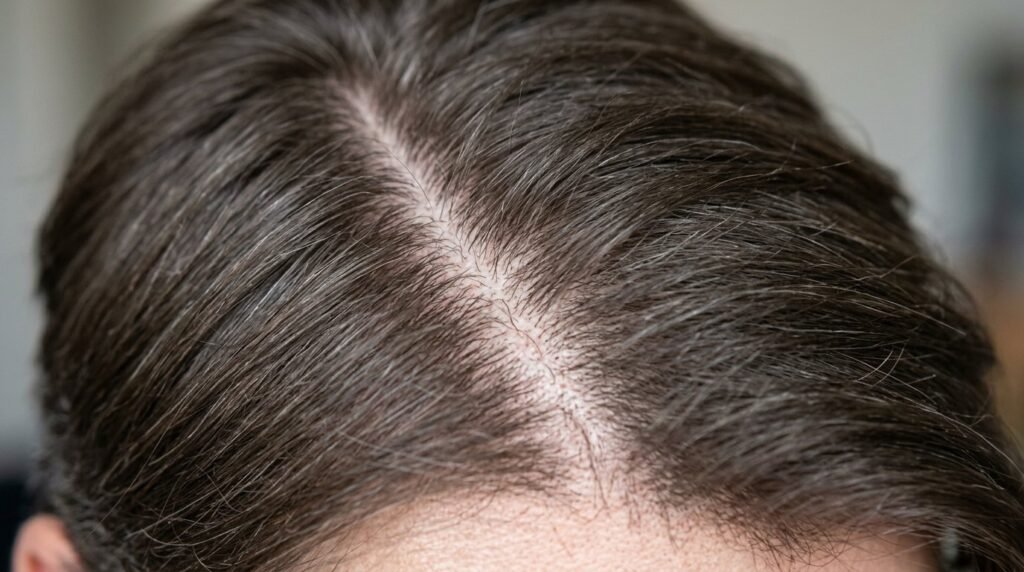
Hair patch density is a comfort decision as much as a visual one. Every extra strand per square inch is insulation. In 40°C heat with 60% humidity, a 130% unit traps noticeably more heat and moisture against the scalp than a 100% one — and that shows up as itching, faster adhesive breakdown and more frequent re-bonds.
If you are in Mumbai, Chennai, Kolkata or the Gangetic belt, treat these as linked decisions:
- Lower density runs cooler. A 20–30% reduction is a real difference over a ten-hour day, not a marginal one.
- Lower density also dries faster after a wash or a workout, which cuts the window in which the base sits damp against the skin — the biggest driver of scalp irritation.
- Lighter units are gentler on the front edge, where tape and glue take the most stress in humidity. If your bonds fail early in summer, density may be part of the reason. The monsoon and humidity guide covers the bond side in detail.
How to tell what density you are actually being sold

Hair patch density is the spec most often left vague at the point of sale, so pin it down before you pay. Five questions worth asking, in writing, on the order:
- “What is the density in percentage terms, and what does 100% mean in your system?” You want a number, not the word “medium”.
- “Is the front edge graduated, and by roughly how much?” If the answer is no, ask for it or plan for the fitter to thin it.
- “Can I see a photo of a unit at this density on a head?” A flat product photo hides density; a worn photo does not.
- “What density do your stock units come at?” Most stock men’s systems in India sit at roughly 110–130%. If you want lighter, say so explicitly.
- “What happens if it is too dense — can it be thinned locally?” Yes, in most cases, but get the answer before delivery, not after.
Expect stock units to feel too dense for the first two to three weeks. A freshly made unit is dyed and coated, the hair sits stiff and uniform, and the density is at its maximum. Washing it three or four times and wearing it softens the look considerably — so judge density after a fortnight, not on day one.
If your unit arrives too dense: the fix ladder

Do these in order, and stop as soon as it looks right. Every step is irreversible.
- Wash it three or four times over two weeks and wear it normally. Natural shedding plus the loss of the factory finish resolves a surprising amount of the problem.
- Restyle the front. A quarter-inch of hair combed forward and slightly back over the hairline creates the illusion of a graduated edge without removing anything.
- Thin with shears, close to the base. A stylist using thinning shears takes roughly half the strands in a section and leaves the rest at full length, which reduces bulk without a visible cut line. Work in small sections and comb out to check after each pass.
- Pluck the hairline and temples, a few hairs at a time, with tweezers. This is the step that fixes a too-solid front edge. Do it dry, do it slowly, and stop before you can see base through the hair.
- Go to a barber who has worked on systems for the sides and back. Cutting the transition against your own hair is a skill, and it is the step that most often rescues a unit that feels wrong.
What not to do: don’t attack the whole unit with shears on day one, don’t pluck in patches (you will create visible gaps), and don’t keep going because it “still feels thick” — density that looks too low in the mirror usually looks correct from a metre away. The care routine covers the washing and drying steps that do half of this work for you.
Density, lifespan and cost

Denser units do last longer in one narrow sense: with more hair to start with, they take longer to look thin. A 130% unit may hold a usable appearance for two to three months longer than a 100% one — but if it never looked right at the start, that is not a saving.
The real cost driver is the base, not the density. Current Wovana pricing, for reference:
| System | Base | Price |
|---|---|---|
| Super Mono | Mono top, thin perimeter | ₹5,999 |
| Mono Hair Patch | Monofilament | ₹7,199 |
| Mono Salt & Paper | Monofilament, grey blend | ₹9,599 |
| USA Super Mono | Super-fine mono | ₹8,999 |
| Curly Mono | Monofilament, textured hair | ₹13,199 |
| Mirage Monofilament | Fine monofilament | ₹15,599 |
| Silk Base | Silk top, poly perimeter | ₹17,999 |
| Golden Silk Base | Premium silk | ₹18,999 |
| Skin / PU 0.08 | Ultra-thin skin | ₹21,599 |
| Paper Thin Poly 0.03 | Thinnest skin | ₹29,999 |
Density is chosen at order and does not usually change the price — which is exactly why it deserves a written line on the order rather than a verbal “normal density, sir”. Sizes run 7×5 to 10×8 inches (width × length) and colour is a separate decision; the size guide and the colour matching guide cover those two, and the price breakdown covers what else moves the number.
Five density mistakes
- Ordering the density you had at 22. Density should match the hair you have now, not the hair you remember. Match your sides.
- Accepting “medium” as a specification. Medium means 110% at one seller and 130% at another. Get a number.
- Ignoring the front edge. A graduated front at 110% beats a flat front at 130% every time.
- Judging on day one. New units are at their densest and stiffest. Give it two to three weeks and four washes before you decide.
- Over-thinning in one session. Density cannot be added back. Thin in passes, check from a metre away in daylight, and stop early.
Keeping hair patch density right over 6–12 months

- Expect a shedding curve. Units shed fastest in the first month, then settle. A 110% unit may read as roughly 100% by month three — usually an improvement.
- Brush gently, twice a day. Aggressive brushing pulls knots and accelerates thinning, especially at the front.
- Wash every 7–10 days, not daily. Over-washing dries the hair and dulls the finish without helping density.
- Keep conditioner off the base. It softens the knot area and makes shedding worse.
- Reassess at the cut-in. Every six to eight weeks, have the stylist check whether the front edge needs a light thin again as the unit settles.
- Replace on appearance, not on a calendar. When the unit stops holding its shape and the base shows through, it is done — that is usually 6–12 months for a mono or silk system. The lifespan guide covers the wear side.
One more link worth making explicit: density affects how much scalp contact adhesive has to survive. If you are getting irritation or frequent lifting, the scalp safety guide covers what to check before you blame the tape.
Frequently asked questions
What density hair patch should I buy for my first unit?
Target a hair patch density of 90–110% for most men, with a graduated front edge. That range looks natural on almost everyone between 30 and 60, shows a little scalp at the part the way real hair does, and runs cooler in Indian summers. Go up to 110–130% only if you are in your twenties with genuinely thick side hair, or if you keep the hairline covered.
Is a 130% hair patch density too thick?
For most everyday wear, yes. 130% looks appropriate on younger wearers with long or voluminous styles and on camera, but on a man in his forties with lighter side hair it reads as a solid block, especially with a short cut or an exposed hairline. It also traps more heat and moisture against the scalp.
Should the hairline be less dense than the rest of the patch?
Yes — this matters more than the overall percentage. Real hair thins towards the hairline and the temples. Ask for a graduated front (roughly 10–15 mm of lighter density), and lighter temples. If your unit arrives with a flat front edge, thinning the first ½ inch is the single most effective realism fix.
Can a hair patch that is too dense be fixed?
Usually, yes. Wash and wear it for two to three weeks first, then have a stylist use thinning shears close to the base, pluck the hairline and temples with tweezers a few hairs at a time, and have a barber blend the sides. Density cannot be added back, so work in passes and stop before it looks thin in daylight.
Does higher density make a hair patch last longer?
It holds its appearance for somewhat longer because there is more hair to lose, but it does not change the base’s lifespan and it costs realism. A well-chosen 100% unit that looks right for eight months is a better buy than a 130% unit that looks wrong for twelve.
Does density affect how hot a hair patch feels?
Yes, noticeably. Every extra strand per square inch is insulation, so a 130% unit traps more heat and moisture than a 100% one. In Indian summer conditions that shows up as itching, faster adhesive breakdown and more frequent re-bonds. Lower density also dries faster after washing or a workout.
How do I measure or check my natural hair density?
Look at the hair above your ear in good daylight: if you can see scalp between strands and the hair separates individually, you are light — choose 85–105%. If the hair sits as a solid mass with no scalp visible, you are heavy — 110–125% will match you. Your side hair is the reference because that is where the patch meets your own hair.
Does density change the price of a hair patch?
Not usually in the Indian market — the base material is the main price driver, from around ₹5,999 for a Super Mono to ₹29,999 for a 0.03 mm skin system. Density is chosen at order, which is exactly why it should be written on the order rather than agreed verbally.
What to do before you order
- Today: check your side hair above the ear in daylight and note whether scalp is visible. That is your density target.
- This week: ask the seller for the density as a percentage, what their 100% means, and whether the front edge is graduated. Get it in writing.
- At the cut-in: ask the fitter to thin the front edge and temples to create the gradient, and to check the density against your sides at one metre in daylight — not in the chair under salon lighting.
Get hair patch density right and everything else — base, colour, size — finally reads the way it should. Get it wrong, and no amount of styling hides a head of hair that is simply too much hair.